Bite, or don't Both sounds live at the lips. Only one thing separates them: whether the lower lip touches the upper teeth. Touching gives v (friction); not touching gives w (no friction). Tiny difference in sound, large difference in mouth shape.
Two sentences, that's all
First settle lip-to-teeth contact, then settle friction.
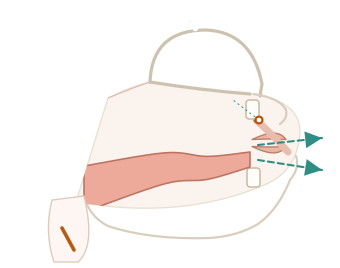
/v/ — lower lip on upper teeth, with friction
Rest the upper teeth lightly on the inner edge of the lower lip; air hisses through the gap while the vocal folds vibrate. Friction and voice must be simultaneous — you should feel buzzing at the throat.
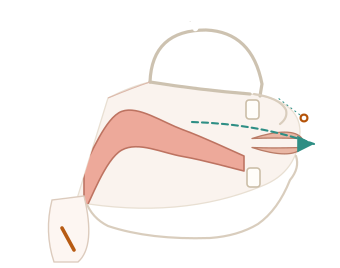
/w/ — lips rounded, no friction at all
Round and push the lips forward as if about to whistle, then glide quickly into the following vowel. The lips never touch the teeth, so the airstream is unobstructed and there is no hiss. It is a glide, not a fricative.
Self-check with a mirror
Say v in a mirror: you should see the lower lip slightly compressed by the upper teeth. Say w: the lips are round and the teeth are hidden. This check beats listening to a recording.
Articulation (side view)
One speaker, one instant: tongue position and lip shape only. The amber circle marks what to look at; the caption says how it differs from the sound it is usually confused with.
Spelling: no ambiguity in the letters, all of it in the sound
v is written v and w is written w — these two almost never cause a spelling problem. The problem is that learners replace /v/ with /w/.
The spelling of /v/ is remarkably stable in English. The handful of exceptions are of (/əv/) and Stephen (/ˈstiːvən/).
w appears only before a vowel. Written before a consonant (write, wrong) it is silent.
Most English and American accents have merged wh into /w/. Only some Scottish and Irish accents keep the voiceless /ʍ/, where which and witch differ.
qu is /kw/: a k plus a w, both pronounced. Reducing it to /k/ loses a sound.
/v/ is spelled f, ph or u in a handful of frequent words. Learn them as a list.
Why they merge
If your first language lacks /v/, it will be replaced by the nearest available sound.
/w/ substituted for /v/
The most common pattern. Without a labiodental voiced fricative, the brain picks a voiced sound near the lips, and w fits.
In Indian English and parts of African English this has become an established variant; for a learner, though, the v/w contrast must be built, because vine and wine are different words.
/f/ substituted for /v/
f and v share the exact same mouth position and differ only in voicing. If your language has f but not v, you learn the lip-teeth gesture and miss the voicing.
Self-check: pinch your nose and say v — nothing changes (air flows through the mouth). If it turns into n, you are using the nasal cavity.
/w/ over-corrected into /v/
The reverse error: having learned v, some learners bite their lip on every w. The key for w is rounded lips that do not touch the teeth.
German speakers tend to take this path, since German w is pronounced as English v.
Final /v/ devoiced to /f/
Many languages allow only voiceless consonants in codas. English allows final voicing, and leave versus leaf are different words.
Compare leave and wave in this page's clips: the final v needs a little voiced length, not an abrupt cut.
Word list
27 words grouped by where the sound sits in the word. Click a word to hear it. These are recorded as separate words, not cut out of the sentences above — a word cut from a sentence carries its neighbours' transitions and always sounds muddier. All three groups use the same speaker, so what changes between them is position, not voice.
Word-initial9
Word-medial9
Word-final9
All nine word-final items are v: /w/ does not occur word-finally. No English word ends in /w/. The sound at the end of now or how is not /w/ — it is the second half of the diphthong /aʊ/.
Corpus and acoustic measurements
Click any word in a sentence to play from that word. The pale band over the waveform marks the measured boundary of the target word.
Per-token data
Every number below is measured directly from the audio, not hand-annotated.
| Token | Accent | Sex | Target | Word length | v / w length | F0 | Pitch range | HNR |
|---|
How the numbers were produced
Every figure on this page can be recomputed from the method below.
Corpus: 12 English sentences synthesised by a TTS engine in 4 American voices (two male, two female), each containing one target word beginning with /v/ or /w/. Audio is 22.05 kHz mono at 64 kbps, each clip running 1.2 s before and 1.5 s after the target word.
Word boundaries: taken from the engine's WordBoundary timestamps and corrected for the constant offset between the engine clock and the audio start (estimated per item). The target word is shaded on the waveform.
Phoneme boundaries: measured boundaries from forced alignment with the MMS_FA acoustic model. The alignment frame span of every character is kept, and a dynamic program maps the character sequence onto the phoneme sequence (th→θ, ng→ŋ, ck→k and similar), placing each boundary at the middle of the transition between characters, with 100% coverage of the word. Temporal resolution is the model frame, 20 ms; because each boundary sits on the midpoint between neighbouring character spans, the effective resolution is about 10 ms.
This changed on 2026-10-19: the previous method looked the word up in the CMU dictionary and distributed the word duration across phonemes by class-specific weights, which measures word length rather than phoneme length. On the vowel pairs it inverted the long/short ordering outright, so the whole chain was moved to acoustic alignment.
Pitch: Praat autocorrelation (to_pitch), 10 ms frame shift, search range narrowed adaptively to the speaker's range and octave errors removed. 'Pitch range' is max minus min F0 within the word.
Why the two durations look alike: v is a fricative and w is a glide, so their internal structure differs; but word-initially before the same vowel their measured extents are very close. Which means duration cannot tell them apart — the difference is spectral (v has high-frequency friction noise, w does not), not temporal.