Final b and p: the vowel speaks for them, but only halfway The last sound of cab and cap is hard to tell apart on its own: a final voiceless stop is unaspirated, and a final voiced stop often keeps only faint vibration. English has a rule that speaks for them — a vowel is longer before a voiced consonant. The question is how reliable that rule is: across these six pairs cab / cap differ by 10 ms and bag / back by 80 ms, while the same d/t pairing falls from 70 ms to 1 ms depending on the word.
Six pairs: three places, two each
Each pair is one vowel with two different final consonants, both read by the same speaker. The number is the measured duration of that vowel.
Three things, and you need all three
Final voicing is not a difference in loudness.
Final voiceless stops are unaspirated
Word-initial /p/ is aspirated (pin releases a puff), word-final /p/ is not (cap barely breathes). So "say it louder" does not help — the contrast is not carried by aspiration.
A vowel before a voiced consonant is longer — but by a wildly varying margin
A rule runs through the whole English system: the same vowel is longer before a voiced consonant than before a voiceless one. All six pairs here use the same vowel and change only the final consonant, so the difference is attributable to voicing.
A final voiced stop is not "plus a schwa"
Final /b/ /d/ /ɡ/ stay fully stopped. cab is not "cab-uh". Adding a vowel turns one syllable into two and shifts the stress.
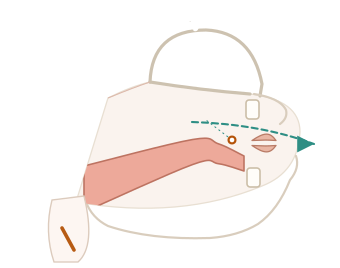
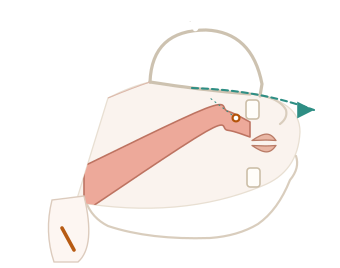
Articulation (side view)
One speaker, one instant: tongue position and lip shape only. The amber circle marks what to look at; the caption says how it differs from the sound it is usually confused with.
Spelling: the one page where the letters do predict the sound
The difference is not in the vowel itself but in the consonant after it — and that consonant is never left out of the spelling.
The vowel before it is longer. The written b, d, g is the cue: when you see one, the vowel can stretch.
The vowel before it is shorter and cut off more sharply. A final voiceless stop is also released with a little aspiration — a second cue, though this page lets only the duration numbers speak.
The letters added are always the same; how they are read depends on whether the sound before is voiceless or voiced. The full rule lives on the -ed / -s page.
Four places learners most often go wrong
Most trace back to one fact: pinyin b/p is an aspiration contrast, not a voicing one.
Treating voicing as aspiration
In pinyin, b and p differ in aspiration; in English, /b/ and /p/ differ in vocal fold vibration. Imitating final voicing with aspiration changes the word onset and still leaves the ending undifferentiated.
Every item on this page is word-final, which removes the aspiration confound — you can concentrate on vowel length.
Making both vowels the same length
This is the direct failure: if the vowels are equal, the listener has only the final consonant to go on, and that consonant is nearly unhearable. The two words then collapse into one.
The difference column is the direct measurement of this failure. Do not treat it as a ruler though: the gap is a few tens of milliseconds, shorter than a single phoneme, and you have to listen for it deliberately.
Devoicing final voiced consonants
Syllables in many languages end in a vowel or a nasal, so final /b/ /d/ /ɡ/ /v/ /z/ tend to be devoiced. Devoiced, bag becomes back.
Self-check: put a hand on your throat for a final voiced consonant — there should be vibration. If it stops, you devoiced it.
Adding a vowel after the final consonant
The extra vowel makes the consonant pronounceable at the cost of the syllable count. cap is one syllable; two syllables break the rhythm and move the stress.
Same root cause as the final-consonant page in the syllable strand, where the contrast is laid out in more detail.
Word list
These groups are voicing of the final consonant, not position: voiced endings, voiceless endings, and one mid-word group as a control. 27 words, click to hear each — all recorded as separate words. The same consonants only cue voicing through vowel length at the end of a word; put them mid-word and the cue is gone, which is why the third group has no long/short contrast.
Voiced endings9
Voiceless endings9
Mid-word (control)9
These three groups are not positions but voicing of the final consonant: in cab vs cap the final stop itself is tiny — the cue is how long the vowel before it runs. The mid-word group is the control: put the same consonants inside a word and vowel length stops being a cue, which is why happy and bigger do not sound long or short.
Corpus and acoustic measurements
Click any word in a sentence to play from that word. The pale band over the waveform marks the measured boundary of the target word.
Per-token data
Every number below is measured directly from the audio, not hand-annotated.
| Token | Accent | Sex | Target | Word length | vowel duration | F0 | Pitch range | HNR |
|---|
Where the numbers come from
Every figure on this page can be recomputed from the notes below.
Corpus: 12 English sentences generated by a speech synthesis engine. Each minimal pair on this page is read by one and the same speaker — the difference is the point, and a change of speaker would inject timbre variation into it.
Word boundaries: taken from the engine's word-level WordBoundary events, with the constant offset between the engine timeline and the audio start corrected per utterance.
Phoneme boundaries: forced alignment with the MMS_FA acoustic model, mapping character-level timestamps onto the phoneme sequence by dynamic programming, at the model's frame is 20 ms and each boundary falls on a midpoint between character spans, so the effective resolution is about 10 ms. These are not durations allocated within the word by an experienced-weight table.
Pitch: computed frame by frame with Praat's autocorrelation (to_pitch), 10 ms frame shift, search range narrowed to the speaker's range estimated from the whole utterance, octave errors rejected.
What this page is: a view of how these sounds are distributed in the given corpus, not a pronunciation standard. Synthetic speech follows duration patterns close to human reading, but is not identical; the numbers will be recomputed once real recordings are wired in.
Why only stops: the first version carried two fricative pairs, /v-f/ and /z-s/, and three of six pairs came out reversed. Re-synthesised across three voices, the vowel differences for fricatives were -1 ms and -10 ms with a 1/3 hit rate — not bad luck: a fricative's own noise runs long and flattens the vowel before it, so the voicing cue is simply not in vowel length there. Only stops suit this measurement.