Palatal approximant · y The front of the tongue body rises toward the hard palate without touching, the tip stays behind the upper teeth touching nothing, and it glides straight into the following vowel. The position is essentially /i/ — only shorter and tenser.
Three steps to /j/
Set the tongue as for /i/, then glide away at once.
Tongue body up, gap kept
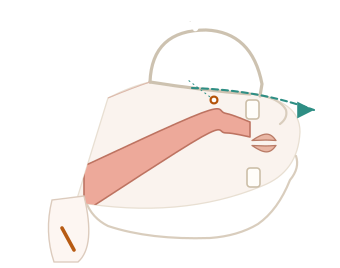
The front of the tongue rises near the hard palate but never touches it. Put this drawing next to /i/: the surfaces sit almost in the same place.
Tip behind the teeth, touching nothing
This is the whole boundary with the pinyin j, which presses the tongue against the palate first. /j/ keeps a gap throughout, so the airstream is never blocked.
Glide into the vowel
/j/ cannot be held — it must slide immediately into the vowel (the /e/ of yes, the /ɪ/ of year). Holding it turns it into /i/.
Articulation (side view)
One speaker, one instant: tongue position and lip shape only. The amber circle marks what to look at; the caption says how it differs from the sound it is usually confused with.
Spelling: y is the usual source, but u carries /j/ too
Initial y is nearly always /j/. So is the u in use, music and huge. Final y is the exception — that one is /i/.
Initial y is essentially always /j/.
use /juːz/, music /ˈmjuːzɪk/, huge /hjuːdʒ/. Not every u carries it: rule /ruːl/, June /dʒuːn/ do not.
ew is /juː/. American new is often /nuː/ without the glide — a regional difference, not an error.
onion /ˈʌnjən/, figure /ˈfɪɡjər/, canyon /ˈkænjən/ — the glide sits between a consonant and a vowel and is invisible in the spelling.
Why learners replace /j/
The affricate trap and the lazy /i/.
Replaced by an affricate
A palatal affricate closes the tongue against the palate first, blocking the air, then releases into friction. /j/ never closes.
In the drawing the gap between tongue and palate is visible for /j/; an affricate closes it.
Flattened to /i/
Since the tongue position matches /i/, the glide is dropped: yes becomes /iːes/, year becomes /iːər/.
/j/ is a glide and takes no syllable of its own. Hold your chin while saying yes — you should feel movement, not a steady vowel.
Final y read as /j/
happy becomes /ˈhæpɪj/, which feels natural if your L1 has a y-like glide at the end of open syllables.
English final y is /i/, and /j/ cannot be a coda. The third word group settles this by ear.
Word list
27 words grouped by where the sound sits in the word. Click a word to hear it. These are recorded as separate words, not cut out of the sentences above — a word cut from a sentence carries its neighbours' transitions and always sounds muddier. All three groups use the same speaker, so what changes between them is position, not voice.
Word-initial9
Word-medial9
Word-final9
★ The third group is not a set of /j/ examples: the final y of happy, city, study is /i/. English phonology forbids /j/ as a coda, so this position has no words at all.
Corpus and acoustic measurements
Click any word in a sentence to play from that word. The pale band over the waveform marks the measured boundary of the target word.
Per-token data
Every number below is measured directly from the audio, not hand-annotated.
| Token | Accent | Sex | Target | Word length | j duration | F0 | Pitch range | HNR |
|---|
Where the numbers come from
Every figure on this page can be recomputed from the description below.
Corpus: 12 English sentences synthesised with four American voices (two male, two female), each containing one target word, covering initial, medial and final positions. Audio is 22.05 kHz mono 64 kbps; each clip runs from 1.2 s before to 1.5 s after the target word.
Word boundaries: taken from the engine's word-level timestamps (WordBoundary) and corrected for the fixed offset between the engine timeline and the audio start (estimated per item). The target word is shaded in the waveform.
Phoneme boundaries: measured by forced alignment with the MMS_FA acoustic model. Each character's aligned frame range is kept, then a dynamic program maps the character sequence onto the phoneme sequence (th→θ, ng→ŋ, ck→k). Boundaries fall in the middle of the transition between characters; within-word coverage is 100%. Time precision is the model frame length, 20 ms, and boundaries are taken at midpoints, so effective resolution is about 10 ms.
Pitch: Praat's autocorrelation (to_pitch), 10 ms frame step, search range narrowed to the speaker's estimated range, octave errors removed. «Pitch range» is max minus min F0 within the word.
Why there are no paired differences here: this is a single-phoneme page. Eight other pages are contrast pages (θ/ð, l/r/n, vowel length) where the numbers come from paired words read by one speaker. A single-phoneme page has nothing to compare against — pairing it with a neighbour would measure that neighbour, which belongs to a different page.