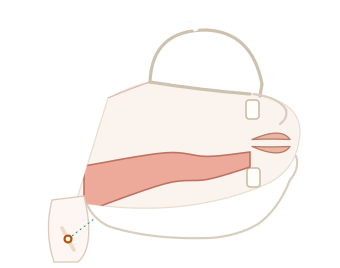
Voiceless glottal fricative · h Nothing happens inside the mouth in this drawing — and that is the whole information. The friction is at the glottis; the tongue and lips are merely carried by the following vowel.
Three steps to /h/
Relax first, then let the vowel set the tongue.
Do nothing in the mouth
Tongue flat, lips neutral, no contact anywhere. This is the only sound on the site that needs no articulatory posture — the neutral tongue is the whole drawing.
Let air rub at the glottis
Like fogging glass, but lighter. The friction is in the larynx, not the mouth. Fingers on the throat feel no vibration, only airflow.
The tongue follows the next vowel
/h/ has no fixed tongue position: the h of hat already anticipates the low front /æ/, the h of heat the high front /i/. A still drawing can only show the neutral case.
Articulation (side view)
One speaker, one instant: tongue position and lip shape only. The amber circle marks what to look at; the caption says how it differs from the sound it is usually confused with.
Spelling: sometimes h is not pronounced at all
h as /h/ is the norm. The trap is the silent h in hour, honest, heir.
Initial h is basically always /h/.
Between two vowels it is also pronounced: behind /bɪˈhaɪnd/.
hour /ˈaʊər/, honest /ˈɑːnɪst/, heir /er/. These take an: an hour, an honest man.
rh- drops the h (rhythm, rhyme); vehicle /ˈviːɪkl/ drops it too.
Why learners replace /h/
Same letter, same symbol, different place of friction.
Replaced by a velar fricative
Many L1s have a velar /x/: the tongue back rises toward the soft palate and the friction is in the back of the mouth. For English /h/ the tongue back stays relaxed.
In the drawing the tongue back is far from the soft palate for /h/; a velar fricative closes that gap.
Dropped entirely
Without a glottal fricative in the L1, he becomes /iː/ and hand becomes /ænd/. In connected speech tell him becomes /tel ɪm/.
That reduction is covered in the connected-speech section; a word-initial h must not be dropped.
Silent h pronounced anyway
Spelling wins and hour becomes /haʊər/.
The article is the test: an hour, an honest man.
Word list
27 words grouped by where the sound sits in the word. Click a word to hear it. These are recorded as separate words, not cut out of the sentences above — a word cut from a sentence carries its neighbours' transitions and always sounds muddier. All three groups use the same speaker, so what changes between them is position, not voice.
Word-initial9
Word-medial9
Word-final9
★ The third group is silent-h words (hour, honest, heir, vehicle, rhythm…). /h/ cannot be a coda in English, so there is no final-position example — and this group is exactly where spelling tempts you to voice the h.
Corpus and acoustic measurements
Click any word in a sentence to play from that word. The pale band over the waveform marks the measured boundary of the target word.
Per-token data
Every number below is measured directly from the audio, not hand-annotated.
| Token | Accent | Sex | Target | Word length | h duration | F0 | Pitch range | HNR |
|---|
Where the numbers come from
Every figure on this page can be recomputed from the description below.
Corpus: 12 English sentences synthesised with four American voices (two male, two female), each containing one target word, covering initial, medial and final positions. Audio is 22.05 kHz mono 64 kbps; each clip runs from 1.2 s before to 1.5 s after the target word.
Word boundaries: taken from the engine's word-level timestamps (WordBoundary) and corrected for the fixed offset between the engine timeline and the audio start (estimated per item). The target word is shaded in the waveform.
Phoneme boundaries: measured by forced alignment with the MMS_FA acoustic model. Each character's aligned frame range is kept, then a dynamic program maps the character sequence onto the phoneme sequence (th→θ, ng→ŋ, ck→k). Boundaries fall in the middle of the transition between characters; within-word coverage is 100%. Time precision is the model frame length, 20 ms, and boundaries are taken at midpoints, so effective resolution is about 10 ms.
Pitch: Praat's autocorrelation (to_pitch), 10 ms frame step, search range narrowed to the speaker's estimated range, octave errors removed. «Pitch range» is max minus min F0 within the word.
Why there are no paired differences here: this is a single-phoneme page. Eight other pages are contrast pages (θ/ð, l/r/n, vowel length) where the numbers come from paired words read by one speaker. A single-phoneme page has nothing to compare against — pairing it with a neighbour would measure that neighbour, which belongs to a different page.