Voiceless labiodental fricative · f The upper teeth rest on the inner edge of the lower lip and air rubs through that gap. Identical to /v/ except for voicing — and the real difficulty is not the start of a word but the end (life, half, enough).
Three steps to /f/
Set the lip-teeth contact first, then voicing.
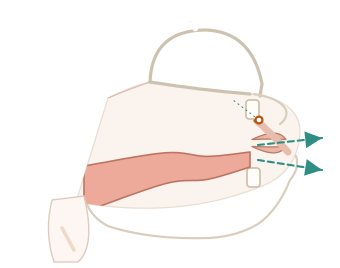
Upper teeth on the lower lip
The upper incisors rest on the inner edge of the lower lip — not the outer surface. That contact point is the whole difference from /w/.
Blow, but do not push
Air escapes steadily through the gap, with no burst. Your fingers on the throat should feel nothing — any vibration turns it into /v/.
Self-check: the final position
A word-initial f is rarely a problem; life, half and enough are. Keep the hand on your throat — the ending must stay voiceless, or life becomes the verb live.
Articulation (side view)
One speaker, one instant: tongue position and lip shape only. The amber circle marks what to look at; the caption says how it differs from the sound it is usually confused with.
Spelling: three sources, and one of them is gh
The letter f is reliable. The traps are gh and ph, which are not f at all yet read as /f/.
Initial, medial and final f all spell the same sound.
Final gh is /f/, not silent. This is the opposite of the gh in night / light, and mixing the two turns laugh into /lɔː/.
ph is /f/ — taught early, rarely a problem.
Double ff is a single /f/ with a shorter preceding vowel.
Why learners replace /f/
The word-initial f is easy. What fails is the final position and gh.
Dropping the final /f/
Many languages allow no f-coda, so life becomes /laɪ/ and half becomes /hɑː/. English has many such words (life, half, roof, safe, knife) — this is a high-frequency error.
The final group on this page exists for exactly this position.
Devoicing fails — /v/ instead
life and live (verb) differ only in voicing. Without a clear voiceless ending the word becomes a different one.
A hand on the throat is the reliable check: no buzz at the end.
The gh is skipped
Readers drop the gh in laugh and enough, producing /lɔː/ and /ɪˈnʌ/.
The pattern: final gh is /f/ (laugh, enough, tough, rough, cough) while gh in igh is silent (night, light, right).
f / h confusion in some regions
Some southern Chinese dialects merge f and h, so fan becomes /hæn/.
The drawings differ completely: /f/ has lip-teeth contact; in /h/ nothing happens inside the mouth.
Word list
27 words grouped by where the sound sits in the word. Click a word to hear it. These are recorded as separate words, not cut out of the sentences above — a word cut from a sentence carries its neighbours' transitions and always sounds muddier. All three groups use the same speaker, so what changes between them is position, not voice.
Word-initial9
Word-medial9
Word-final9
Three groups of nine. Watch the spelling in the final group: laugh and enough write their /f/ as gh, the other seven as f.
Corpus and acoustic measurements
Click any word in a sentence to play from that word. The pale band over the waveform marks the measured boundary of the target word.
Per-token data
Every number below is measured directly from the audio, not hand-annotated.
| Token | Accent | Sex | Target | Word length | f duration | F0 | Pitch range | HNR |
|---|
Where the numbers come from
Every figure on this page can be recomputed from the description below.
Corpus: 12 English sentences synthesised with four American voices (two male, two female), each containing one target word, covering initial, medial and final positions. Audio is 22.05 kHz mono 64 kbps; each clip runs from 1.2 s before to 1.5 s after the target word.
Word boundaries: taken from the engine's word-level timestamps (WordBoundary) and corrected for the fixed offset between the engine timeline and the audio start (estimated per item). The target word is shaded in the waveform.
Phoneme boundaries: measured by forced alignment with the MMS_FA acoustic model. Each character's aligned frame range is kept, then a dynamic program maps the character sequence onto the phoneme sequence (th→θ, ng→ŋ, ck→k). Boundaries fall in the middle of the transition between characters; within-word coverage is 100%. Time precision is the model frame length, 20 ms, and boundaries are taken at midpoints, so effective resolution is about 10 ms.
Pitch: Praat's autocorrelation (to_pitch), 10 ms frame step, search range narrowed to the speaker's estimated range, octave errors removed. «Pitch range» is max minus min F0 within the word.
Why there are no paired differences here: this is a single-phoneme page. Eight other pages are contrast pages (θ/ð, l/r/n, vowel length) where the numbers come from paired words read by one speaker. A single-phoneme page has nothing to compare against — pairing it with a neighbour would measure that neighbour, which belongs to a different page.